The Herbalist Who Turned Away — Wong Tai Sin and the Gift That Was Refused
“"True healing asks nothing in return. When it does, it is no longer healing — it is trade."”
“— Taoist teaching, in the tradition of Huang Chu Ping”
Introduction
黄大仙 — Wong Tai Sin, the Great Immortal Wong — is venerated across Guangdong, Hong Kong, and the Chinese diaspora as a healer whose power flows from selfless virtue. His legend begins with a humble shepherd boy who became an immortal through decades of sincere cultivation in the mountains. This story, set in the era before his veneration was widespread, speaks to the root of that power: a gift refused at the moment of greatest temptation.
The Story
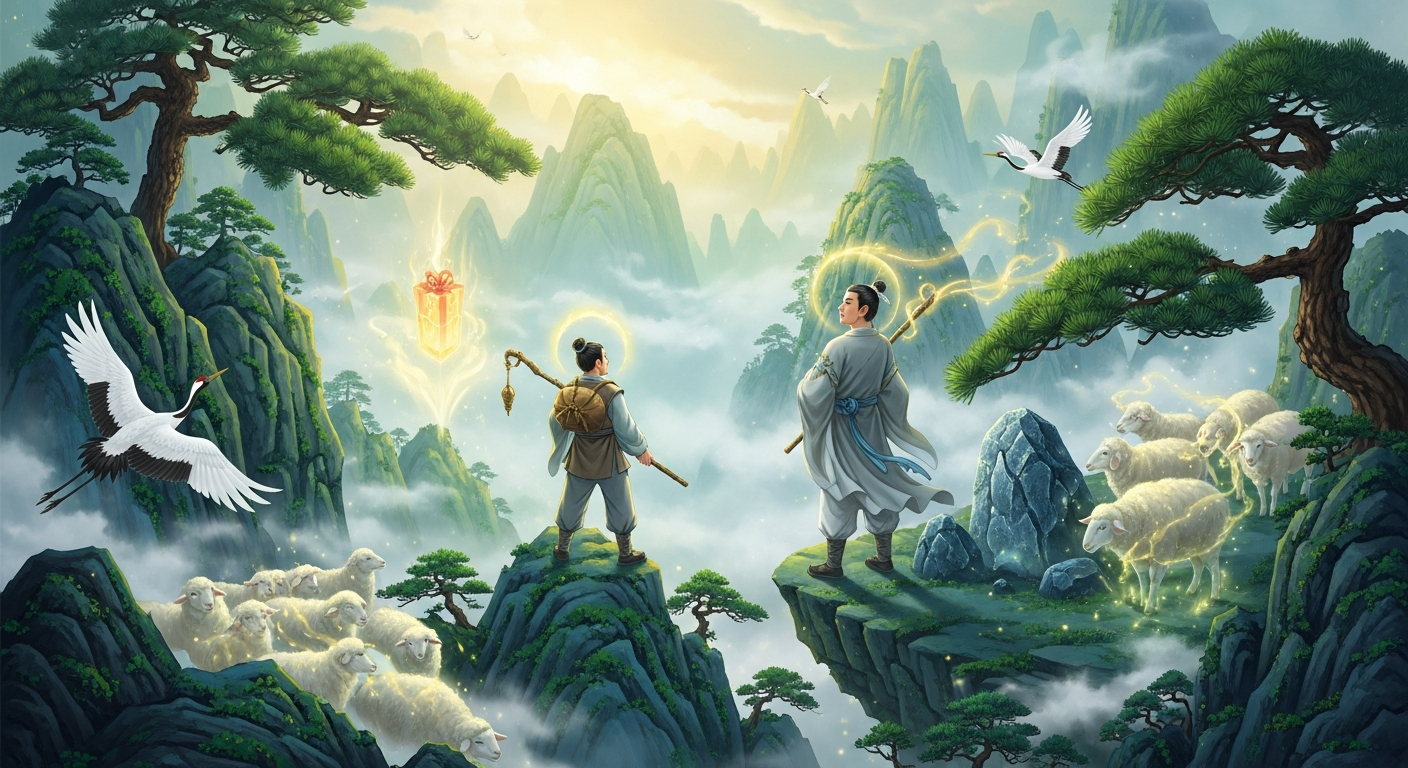
Huang Chu Ping had been living in the mountains of Zhejiang for many years, studying the way of herbs and qi, when word began to spread in the valley below that a hermit healer could cure what village doctors could not.
The sick were carried up the mountain paths. The lame, the fevered, the afflicted came in streams. Huang Chu Ping turned no one away. He gave his knowledge freely — the correct herbs, the timing, the preparation. He asked for nothing.
One autumn, a wealthy merchant came up the mountain with a retinue of servants. His son had been ill for two years — a wasting sickness that had cost the family a small fortune in failed remedies. The merchant brought gold. He spread it on a flat stone before Huang Chu Ping, more gold than most families would see in three generations.
"Heal my son," he said, "and all of this is yours."
Huang Chu Ping looked at the gold for a long moment. Then he looked at the boy — pale, thin, eyes still sharp with the fear of dying young.
"I will see your son," he said. "Put the gold away."
The merchant, accustomed to buying what he needed, grew irritated. "Name your price then. Whatever you ask."
Huang Chu Ping said gently: "If I accept payment for healing, I begin to calculate who deserves it. The poor man who cannot pay will receive less of my attention. The rich man will receive more. That is not medicine. That is commerce. I will not practise commerce."
He treated the boy over ten days. On the eleventh day, the fever broke. The boy sat up and asked for soup.
The merchant wept. He pressed the gold forward again.
Huang Chu Ping shook his head. "Your gratitude is already more than enough. Take the gold home. Use it to ensure your son lives well."
The merchant went down the mountain a different man. He later endowed a free clinic in the valley that ran for forty years.
Reflection
Wong Tai Sin's veneration is inseparable from this quality: healing as an expression of virtue, not a vehicle for gain. In his temples, worshippers often pray not just for cures but for clarity — for the wisdom to help where they can and to release what they cannot control.
The merchant's gold was real. The temptation was real. What Huang Chu Ping refused was not the money but what the money would have done to the healer inside him. This is the teaching: some gifts, accepted, cost more than they give.
Closing Prayer / Dedication
May Wong Tai Sin's virtue guide all healers, caretakers, and those who serve — that their gifts remain untainted by calculation, and that every act of care flows from a full and willing heart.
黄大仙,慈悲大德,佑我众生 🙏
转身的草药医者——黄大仙与那份被拒绝的礼物
“"真正的治愈,不求任何回报。一旦有所求,便不再是治愈,而是交易。"”
“——道家教义,取意于黄初平传承”
引言
黄大仙——广受广东、香港及海外华人崇奉的大仙——以无私之德为根基,行医济世之名远播。他的传说,始于一位虔诚修炼于山中数十年的牧羊童子,终成仙道。这个故事发生于他的信仰尚未广传的年代,触及其神力的根源:在最大诱惑前,一份被拒绝的礼物。
故事
黄初平在浙江山中修行多年,研习草药与气道。山下谷中渐渐流传:有一位隐居的医者,能治村医束手无策之症。
病患被抬上山路,跛者、热病者、受苦者接连而来。黄初平一概不拒,将知识无偿给予——正确的药草、时机、炮制之法。他从不要求任何回报。
一个秋天,一位富商携一队随从上山而来。他的儿子病了两年——一种让家族耗尽财富却毫无起色的消耗之疾。商人带来黄金,将其摆在黄初平面前的一块平石上,那是普通人家三代都难见到的财富。
"治好我儿子,"他说,"这一切都是你的。"
黄初平凝视那堆金子片刻,然后看向那个男孩——面色苍白,形销骨立,双眼里仍有年少者对死亡的恐惧。
"我会看你儿子的病,"他说,"把金子收起来。"
商人习惯了用钱买得一切,不禁恼怒起来:"那你开个价,要什么都行。"
黄初平平和地说:"一旦我接受酬劳,便开始盘算谁值得被治愈。付不起钱的穷人,我的心思便会少分几分;富人便会多得几分。那不是医术,那是买卖。我不做买卖。"
他为那男孩诊治了十天。第十一天,退烧了。男孩撑起身子,开口要一碗汤喝。
商人泪流满面,再次将金子向前一推。
黄初平摇头:"你的感激,已远胜于一切。把金子带回家,用它让你儿子好好生活。"
商人下山时,已是另一个人。后来,他在谷中捐建了一所义诊,延续了四十年。
感悟与启示
黄大仙的信仰,与这种品质密不可分:治愈是品德的体现,而非谋利的手段。在他的庙宇中,信众祈求的不只是痊愈,更是明辨——知道在哪里可以帮助,也懂得放手那些无能为力之事。
商人的黄金是真实的,诱惑是真实的。黄初平拒绝的,不是那笔钱,而是接受那笔钱后,那个医者内心将会发生的变化。这便是教导:有些礼物,一旦接受,失去的比得到的更多。
结语与回向
愿黄大仙的品德,引导所有医者、照顾者与服侍之人——愿他们的恩赐不受算计的玷染,愿每一份关怀,皆发自充盈而真诚的心。
黄大仙,慈悲大德,佑我众生 🙏
Explore Other Deities · 了解其他神明
To know more about other deities and decipher their oracle lots, visit: