"The man who knows he has enough will always have more than the man who does not."
Introduction
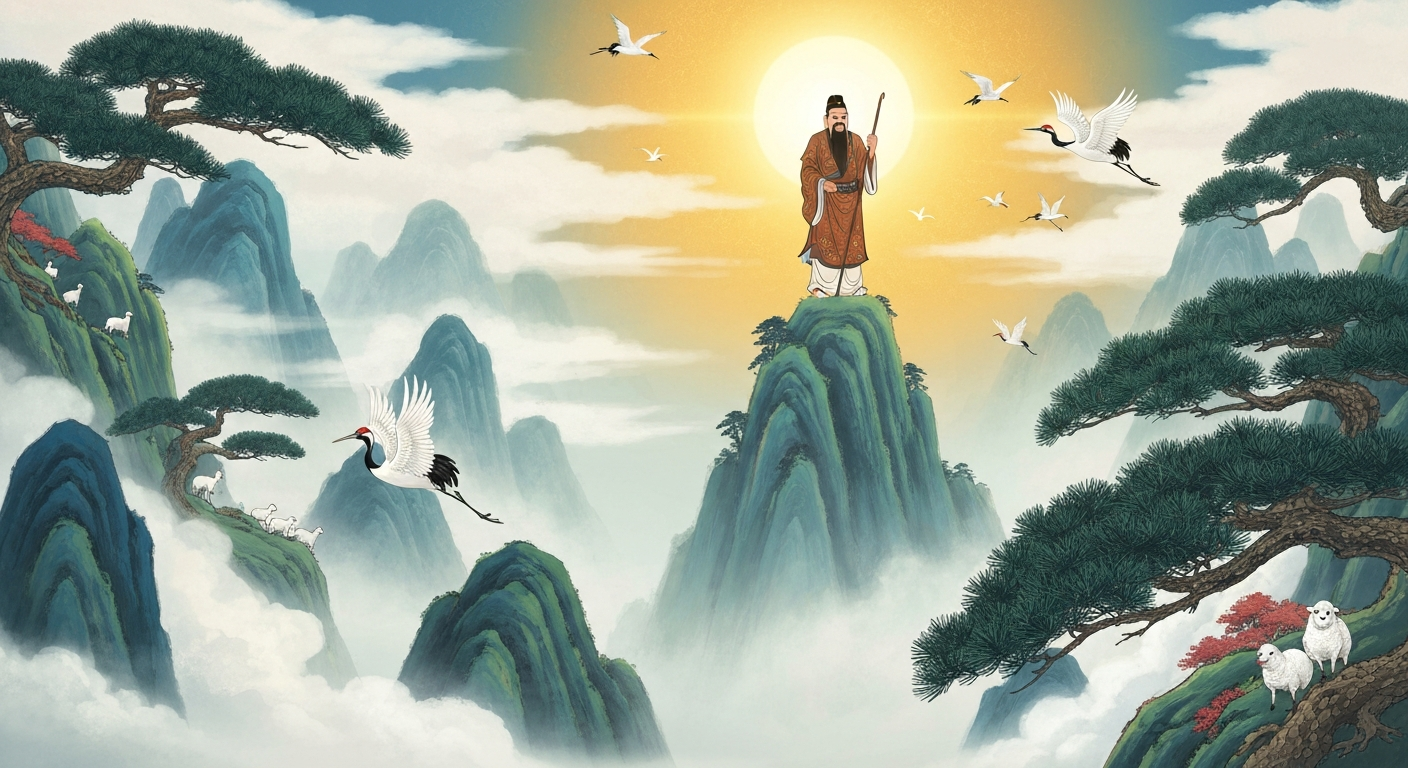
黄大仙 — Huang Da Xian, the Great Immortal of the Yellow, known in Cantonese tradition as Wong Tai Sin — began his spiritual life as a humble shepherd boy tending flocks in the mountains of Zhejiang. He did not begin in a palace or a position of power. He began with the simplest of lives — earth, animals, open sky — and from that simplicity he cultivated something the world's wealthiest cannot buy: contentment.
This essay reflects on the virtue of 知足 — zhī zú, knowing when one has enough — and its companion virtue, gratitude. Together, these form the foundation of a peaceful life and a generous heart.
The Restlessness of "Not Enough"
The world is very good at convincing us we need more. More money, more recognition, more achievement, more security, more time. This conviction — that we are perpetually insufficient, that happiness is just one more acquisition away — is one of the great sources of human suffering.
The Taoist and Buddhist traditions that Huang Da Xian draws from understood this clearly. They saw the grasping mind — always reaching, never settled — as the root of unease. Not because wanting is wrong, but because wanting without gratitude for what already is creates a life of endless thirst beside a river.
Huang Da Xian's life of a shepherd who became an immortal healer is, in part, a teaching about this: that the simplest conditions contain within them everything needed for wisdom, compassion, and a meaningful life. The flock did not need to be a dynasty. The mountain did not need to be a capital. The humble boy with a flute needed no palace to become a saint.
Gratitude as a Practice, Not a Feeling
Gratitude is often treated as a feeling — something we experience when good things happen, and lose when they don't. This is gratitude as reaction. The deeper practice is gratitude as orientation — a habitual turning of the attention toward what is present, what is given, what sustains us, whether or not we feel it in the moment.
This kind of gratitude requires effort, especially in hard times. When illness is present, can we find gratitude for a body that has carried us this far? When finances are tight, can we find gratitude for what we have, rather than fixating on what is absent? When relationships are strained, can we find gratitude for the fact that we are not alone in the world?
These are not easy questions. But they are the questions that shift the quality of a life. People who practise gratitude — not as a spiritual performance, but as a sincere, daily reckoning with what they have been given — are consistently found to be more resilient, more generous, and more at peace than those who do not.
The Generosity That Flows from Contentment
There is a paradox at the heart of contentment: the person who knows they have enough becomes, over time, one of the most generous people in any community. Because when we are not anxious about running out, we can give freely. When we do not feel we are in competition for scarce resources, we can celebrate others' good fortune without resentment.
Huang Da Xian is remembered as a healer — one who gave his gifts freely to those who came seeking help. This generosity was not despite his simple life; it was made possible by it. He was not hoarding against future lack. He was living from a place of inner abundance — the abundance that comes not from having much, but from needing little.
This is the art of enough.
Reflection / Lesson
知足常乐 — "Those who know contentment are always happy" — is one of the oldest Chinese proverbs, rooted in the Tao Te Ching. Its wisdom is not that we should stop striving or stop hoping. It is that the striving should arise from a place of wholeness, not from a place of lack.
When we strive from lack, we remain restless even in success. When we strive from wholeness — grateful for what is, open to what may come — we find that each step of the journey is already worth taking, regardless of where it leads.
Huang Da Xian's example invites us to look, today, at what we already have — and to receive it, with clear eyes and a quiet heart, as the gift that it is.
Closing Prayer / Dedication
May the Great Immortal bless all who seek healing and peace today. May we find in the life we already have — however simple, however imperfect — the seeds of contentment and gratitude. May we know when we have enough, and in knowing, may we become generous.
黄大仙,广济群生,普降吉祥。🙏
知足的艺术——黄大仙与感恩知足的德行
"知道自己已够的人,永远比不知道的人拥有更多。"
引言
黄大仙——粤语传统中的黄大仙师——其灵性之路始于浙江山间的一名牧羊童,放牧牲口,平凡度日。他并非从宫殿或权位出发,而是从最朴素的生命形态起步——土地、牲畜、旷野天空。从这份朴素之中,他修炼出一种世上最富有的人也无法用金钱购得的东西:知足。
这篇文章探讨"知足"的德行,以及与之相伴的感恩。这两者共同构成了平静生命与慷慨心灵的根基。
"不够"的焦躁
世界非常善于让我们相信自己需要更多——更多金钱、更多认可、更多成就、更多安全感、更多时间。这种信念——认为自己永远匮乏,幸福就在下一次获取之后——是人类苦难最深的根源之一。
黄大仙所传承的道家与佛家传统,对此看得清明。他们看见那颗不断抓取、永不安定的心——无休止地伸手,无时停歇——是一切不安的根源。不是因为想要本身有错,而是因为没有感恩地想要——在完全拥有的情况下仍感匮乏——让人如同立于河边而渴死。
黄大仙从牧童成仙的一生,部分便是关于这一点的教化:最朴素的境遇,已包含智慧、慈悲与有意义人生所需的一切。羊群不必是王朝,山野不必是都城。那个手持竹笛的朴实少年,无需宫殿,便能成为一位圣者。
感恩:不是感受,而是姿态
感恩常常被视为一种感受——好事发生时我们体验到它,不顺时便失去它。这是被动的感恩。更深的修行,是将感恩作为一种"朝向"——习惯性地将注意力转向已有之物、被赋予之物、滋养我们之物,无论当下是否感受得到。
这种感恩需要努力,尤其在艰难时刻。当疾病缠身,我们能否为一具将我们承载至此的身体感恩?当财务拮据,我们能否将目光转向已有之物,而非执着于缺失?当关系紧张,我们能否为自己并非独自在世而感恩?
这些不是容易的问题。但正是这些问题,改变了一种生命的质地。真诚地、日复一日地清点所被赐予的——而非将感恩作为灵性表演——这样的人,一贯地比不这样做的人更有韧性、更慷慨、更平和。
从知足流淌出的慷慨
知足之心有一个悖论:知道自己已够的人,随着时间流逝,往往成为身边最慷慨的人。因为当我们不再为耗尽而焦虑,便能自由地给予。当我们不觉得自己在为稀缺资源相互竞争,便能无嗔地为他人的好运而欢喜。
黄大仙以治愈者闻名——他将天赋自由给予前来求助的人。这份慷慨,不是尽管他生活简朴才能给出的,恰恰是因为简朴才成为可能。他不是为未来的匮乏而囤积。他从内心丰盛之处给予——那种丰盛,不是来自拥有得多,而是来自需要得少。
这便是知足的艺术。
感悟与启示
"知足常乐"——这句出自《道德经》根脉的古老谚语,其智慧不是叫我们停止追求或停止期望,而是:追求应当从圆满之处生发,而非从匮乏之处生发。
从匮乏而追求,即便成功也依然焦躁。从圆满而追求——感恩当下所有,开放地迎接未来——我们便会发现,旅途的每一步本身已值得走,无论通向何方。
黄大仙的示范,邀请我们今日看一看自己已经拥有的——以清明的眼神、宁静的心,将它接收为本就是的礼物。
结语与回向
愿黄大仙庇佑今日所有寻求疗愈与平静的人。愿我们在已有的生命中——无论多么朴素,无论多么不完美——找到知足与感恩的种子。愿我们知道何为已够,并在知晓之中,变得慷慨。
黄大仙,广济群生,普降吉祥。🙏
Explore Other Deities · 了解其他神明
To know more about other deities and decipher their oracle lots, visit: